


undefined
No data
Calendar Production, Calendar Printing, Calendar Design
发布时间:2021-09-26 18:33
-
File size: 111.2KB
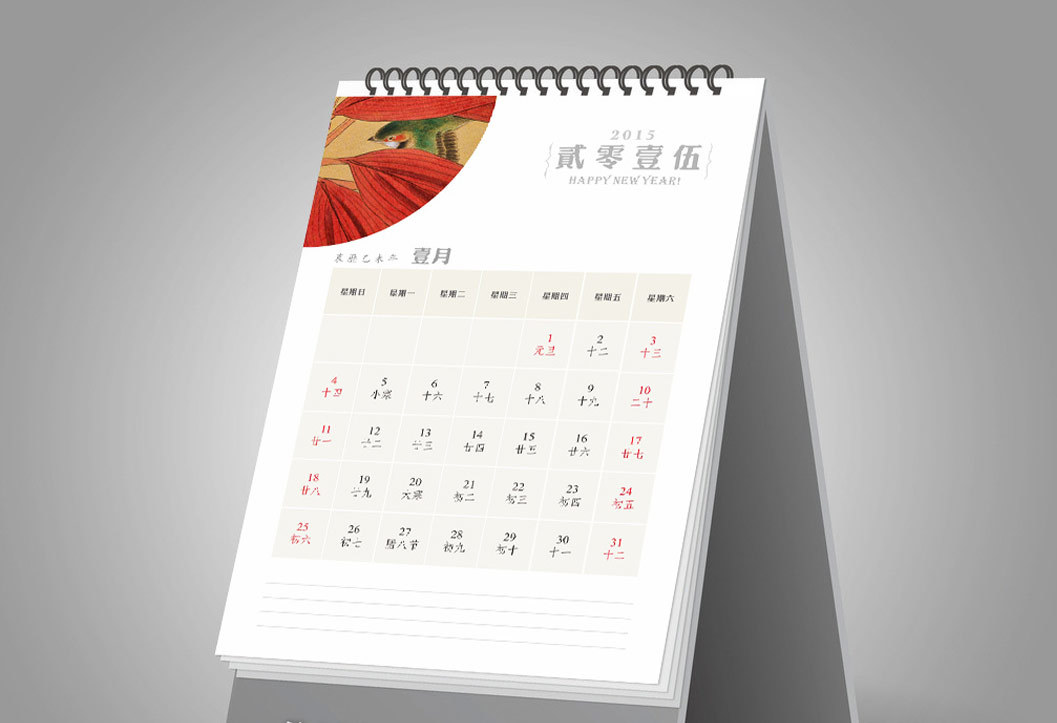
The history of calendars in China dates back approximately four thousand years. A page from an oracle bone calendar unearthed from the Yin dynasty shows a relatively advanced level of calendar-making at that time. This oracle bone calendar page is the oldest physical calendar in the world, also known as a daily calendar.
A Tang dynasty poem reads, “山中无历日,寒尽不知年 (In the mountains there is no calendar, and one doesn't know how long winter lasts).” ‘历日 (lì rì)’ may have been the earliest desk calendar. During the Tang dynasty, court historians would cut paper daily, bind it into volumes, with one volume per month. Each page recorded the month and date with blank space for court eunuchs to record the emperor's actions. This was the ‘历日 (lì rì)’. At the end of each month, it was submitted to the emperor for review before being archived by the historians for use in compiling the official history. Because of its function in recording time and events, civil and military officials emulated this practice.
Early Development
Historical records indicate that calendars were used in the imperial palace around 1100 years ago, in the first year of the Yongzhen era during the reign of Emperor Shunzong of Tang. These calendars, also called imperial calendars, not only recorded dates but also served as essential material for compiling the official history. These early calendars were similar to a point system, dividing a year into twelve volumes, with the number of pages in each volume determined by the number of days in the corresponding month. The month and date were written on each page. These were temporarily kept by eunuchs serving the emperor. The eunuchs recorded the emperor's daily activities in the blank space on each page and submitted the calendar to the emperor at the end of each month for approval. After approval, it was sent to the court historians who integrated the information from the calendar with major national and regional events, refining and polishing it before recording it in the official history.
Later, because calendars brought convenience to life, they gradually entered the homes of many high-ranking officials, undergoing changes to become customized family calendars. With the development of the calendar into something more commonplace and suitable for families, people began to print the stems and branches, the lunar months, solar terms, and auspicious dates on calendars, leaving large blank spaces for noting events.
As for the development of calendars into hanging calendars, desk calendars, and other forms, that is a relatively recent phenomenon, occurring within the last century. The evolution of desk calendar designs from simple styles to many variations has been driven by market economics and the prevalence of the Internet, which has increased cultural exchange. Desk calendars have generally become smaller and more refined.
Scenery,Concept,Calendar,Archive
Previous article
Previous article
Contact Us

National unified service hotline
400-161-3388
No.6 (F1-F9), Residential Quarter B, South of Leping Town Central Science and Technology Industrial Zone Planning, Sanshui District, Foshan City, Guangdong Province
Powered by www.300.cn | SEO Tags | Privacy Policy