


【Safety Notice】Beware of these "wild children"
Release time:2017-09-01
News Event
On June 28, 2015, Yu and his relatives picked wild mushrooms on the mountain in Kowloon Bay. After returning home, they stir-fried them with green peppers and garlic. The next morning, Yu woke up vomiting and having diarrhea, while his two daughters vomited multiple times after being sent to school.
On June 29, 2016, according to the Labor Daily, the emergency room of Ruijin Hospital revealed that it had recently received three patients who had been poisoned by eating "wild mushrooms." After strenuous rescue efforts, two patients were out of danger yesterday; however, another patient who had consumed a larger quantity of poisonous mushrooms died.
Food Safety
Wild mushroom poisoning incidents have occurred from time to time. This is because many people rely solely on "folk methods" circulating online or personal experience to harvest and consume them. According to official professionals, there is currently no quick and reliable method to identify the toxicity of wild mushrooms. Identifying the toxicity of wild mushrooms solely through visual observation is very unscientific. Some "folk methods" for identifying poisonous mushrooms are circulating online and among the public; however, these "folk methods" are unreliable. Many poisonous mushrooms and edible mushrooms do not have obvious differences in appearance or common characteristics. Therefore, the most fundamental way to prevent mushroom poisoning is to not pick or eat wild mushrooms. Do not even consume mushrooms growing in your own garden.
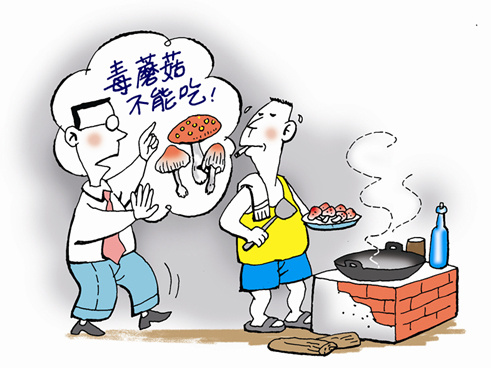
Misconceptions about Identifying Wild Mushrooms
Misconceptions and Truths of Folk Methods
Misconception One
Brightly colored mushrooms are poisonous; those with plain colors are not.
Truth One
It is unreliable to judge whether wild mushrooms are poisonous based on color. Some wild mushrooms that are not brightly colored and look ugly may also be poisonous, such as the Galerina marginata and the Galerina autumnalis.
Misconception Two
If mushrooms are cooked with silverware, garlic, or rice, and the liquid turns black, it proves that they are poisonous; if it does not turn black, it proves that they are not poisonous.
Truth Two
In fact, mushroom toxins do not react chemically with silverware, garlic, etc., and therefore cannot cause color changes.
Misconception Three
I have eaten the "same" mushrooms before without experiencing food poisoning.
Truth Three
Mushrooms with similar appearances may be different varieties or have mutated, or even been contaminated by toxic substances.
Misconception Four
Poisonous mushrooms will release milky sap when damaged.
Truth Four
This statement is unscientific. The milky sap released by Lactarius volemus and Lactarius deliciosus will turn blue-green when injured, but both are delicious edible fungi.
If you experience nausea, dizziness, or auditory hallucinations after eating wild mushrooms, you should immediately use simple methods to induce vomiting and call 120 to go to the hospital as soon as possible. At the same time, keep the wild mushroom samples for medical personnel to use as a reference for treatment. Because there is currently no effective treatment for poisonous mushrooms, we must be careful of these "wild children" from the root to avoid "inviting trouble".
In the roof building materials industry, there are also many restless "wild children" infringing on consumers' rights.
"Porcelain White" PVC tiles produced by a small domestic factory
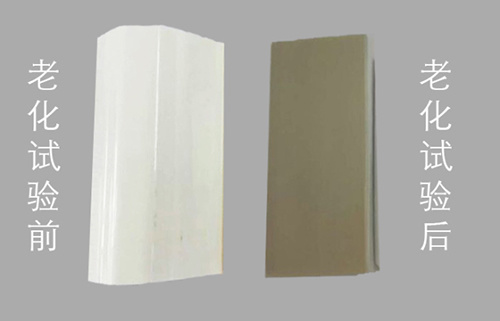
After a 100-hour aging test, ΔE (color difference change) = 7.96
Malicious competition in the market has also brought about many so-called "innovations"! For example, white PVC tiles. Some small factories that do not understand PVC technology, in order to attract customers' attention, produce white PVC tiles as"Porcelain white." "Porcelain white" products are not necessarily bad, but the cost is very high!However, the Price of these small factories' "porcelain white" products is surprisingly cheap! Hongbo technology experts know at a glance where the "trick" is. After only 100 hours of aging testing, the product has shown obvious yellowing, and the experiment showsΔE (color difference change) = 7.96, which is far beyond the acceptable range of color difference tolerance (0-2.0).Most consumers may not understand the meaning behind the color difference change.
In fact, evaluating the quality of a product after aging mainly involves the following two points:
1. Whether the appearance color has changed and the degree of change; 2. Whether the physical properties of the product have decreased and the degree of decrease.
For white PVC tiles, the more yellowing occurs after aging (i.e., the greater the color difference), the more severe the aging (high-quality white PVC tiles will become whiter, not yellower, with the passage of time, Others excluded). Therefore, we can basethe degree of color difference change to judge the quality of white PVC tiles.
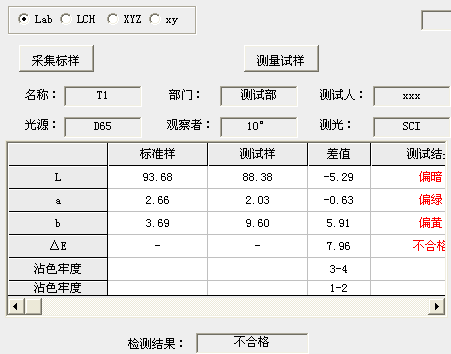
Color difference test of the product: Data comparison of LAB value method
As shown above, whether it is visual judgment or experimental data, the"Porcelain white" PVC tilesproduced by a certain small domestic factory have undergone serious aging after 100 hours of aging testing,Aged PVC tiles will show powdering, embrittlement, or reduced tensile strengthand other varying degrees of deterioration. If put into actual use, it may cause serious economic losses.
PVC Product Science
In nature, the main factors affecting the aging of PVC products are light, heat, and moisture (water), among which ultraviolet rays and high temperatures have a stronger destructive effect on PVC molecules. Therefore, considering these characteristics, manufacturers who pay attention to quality will fully consider the aging problem in the reprocessing and use of PVC products when designing the product formula:
1. For thermal aging, high-quality heat stabilizers and antioxidants should be added;
2. For ultraviolet light aging, anti-ultraviolet light additives (commonly known as UV in the industry) should be added;
3. Due to the characteristics of PVC resin (the processing melting temperature is very close to the decomposition temperature), various functional adjuvant combinations need to be added during the processing process.
However, some manufacturers, in pursuit of vibrant product colors, may irrationally add or excessively add certain adjuvants, such as plasticizers, whiteners, brighteners, etc. While such products may appear bright and vibrant, and may have minimal short-term impact in indoor use, they can cause damage to essential product properties (such as heat resistance, rigidity, and aging). For instance, adding fluorescent whitening agents, although making the product exceptionally bright, accelerates yellowing and aging (fluorescent whitening agents are taboo in outdoor product formulas). Therefore, exercise caution when choosing products with exceptionally bright or glossy surfaces.
Hongbo APVC Tile
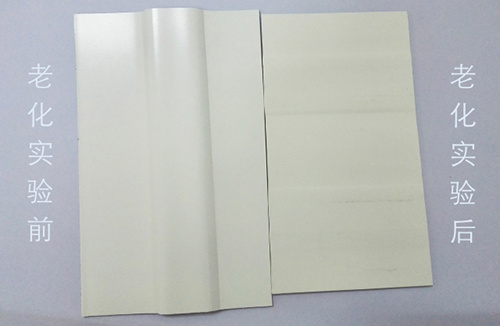
After a 100-hour aging test, ΔE (color difference change) = 0.92
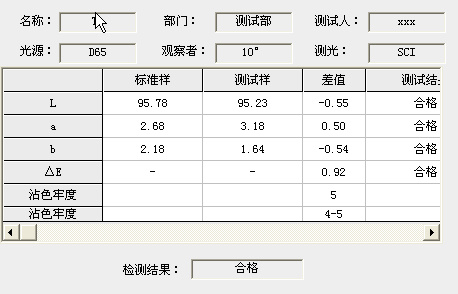
Hongbo APVC Tile Color Difference Test: Data Comparison using LAB Method
Choosing PVC tiles is like encountering wild mushrooms; we cannot directly identify their quality with the naked eye. However, we can choose high-quality Brands or manufacturers with strong production and R&D capabilities, such as Guangdong Hongbo Building Materials, which has passed the "strength certification" of CCTV's "To Craftsmanship" program.
Hongbo Building Materials' R&D team considers various factors, including product category, application, safety, reasonable cost, and aging, when designing PVC product formulas and selecting materials. They strive to find the optimal material combination and all products undergo extensive testing and verification to ensure the highest quality for consumers.
Technical data provided by: Engineering Research Center
Edited by Wu Yunhua

Related News
Contact Us

National unified service hotline
400-161-3388
No.6 (F1-F9), Residential Quarter B, South of Leping Town Central Science and Technology Industrial Zone Planning, Sanshui District, Foshan City, Guangdong Province
Powered by www.300.cn | SEO Tags | Privacy Policy